Search This Blog

Tuesday, 10 September 2013

ROMANTIC…FOR LOVERS. A Philips Instrumental Collection from the early 1980s.

If you have ever looked back nostalgically at the hundreds of vinyl easy listening LPs from the late 1960s and 1970s that you wished were updated for digital formats, PHILIPS (Netherlands) tried to satisfy this demand through their ‘romantic instrumentals for lovers’ series. It states on the back cover of each piece of their series that the compilation was done by Fred Stam, and digital remastering by Gert van Hoeyen. This was also part of a pioneering series of easy listening mixed artiste compilations issued by Philips worldwide – in limited quantities – reissued and remastered from their Vinyl archives in Europe – hence the mostly European lineup of artistes.
This is easy listening from the era before the arrival of the CD. It was also a time when many European practitioners of mood music were blending jazz, light orchestral work and popular melodies. Interestingly, PHILIPS’ artistes such as Piet Souer, Wim Overgauuw, Rogier van Otterloo, Piet Noordijk, Tonny Eyk and Clous van Mechelen were little heard outside the Continent. Until, they were packaged in this series.
 The format and tone of this five-instrumental-and-one-vocal CD set is in the fashion of ‘soft lights sweet music’. Perfect music to accompany the end of a hard day in a dimmed down living room, or a quiet cocktail lounge. Better still, imagine mood lighting in a teak wood paneled reading room or private home mini-bar – and you’re set to dig into these mouthwatering sets.

Now here’s a listing of the sets featuring the Piano, Guitar, Saxaphone, Clarinet and Flute. All or most pieces are performed with either a quartet or a full studio orchestra. You might know of the sixth, and missing piece, ROMANTIC POPSONGS FOR LOVERS, but I personally don’t feel it is worth listing here since the songs were the everyday variety you can find in love song compilations around the early 1980s. Incidentally, some of these collections were also released on cassette at the same time – hence the picture on the right – indicating how PHILIPS was reaching out to both ‘old’ and ‘new’ fan bases.

First up, Romantic Piano for Lovers. Made in West Germany and released by PHILIPS Netherlands in 1983. Catalogue no. 814281-2. This is music that takes you places for a romantic holiday and to the most bewitching destinations in Europe: ‘Chanson pour Milan’, ‘La Comparsa’ and ‘Sunrise Serenade’ are evocative of sunny Italy; while ‘Moonglow’, ‘Imaginary Landscapes’ and ‘Meditation’ transport you to the most beautiful art museums of your imagination. ‘Love Story’, ‘Ballade pour Adeline’ and ‘Strangers in the Night’ are also fine gems that stud an already glowing landscape of piano masterpieces. Horst Jankowski delivers an exceptionally haunting and uptempo version of Strangers in the Nights that must be heard to be appreciated; while Jules Corte’s version of Leroy Anderson’s ‘Forgotten Dreams’ must surely be dubbed the serenade for little ballerinas given its light airy fleeting tones!
TRACK LISTING:
1. Ballade Pour Adeline - René Clermont [2:52]
2. Meditation - Antonio Carlos Jobim [3:19]
3. La Comparsa - Hans Van Eick [3:54]
4. Imaginary Landscapes - Laurens Van Rooyen [4:05]
5. Chanson Pour Milan - Tonny Eyk [3:05]
6. Sunrise Serenade - Horst Jankowski [3:04]
7. Just A Simple Love Song - Laurens Van Rooyen [3:30]
8. Desafinado - Antonio Carlos Jobim [2:45]
9. Love Story - René Clermont [3:26]
10. Forgotten Dreams - Jules De Corte [3:29]
11. Moonglow - Pim Jacobs Trio [4:01]
12. Strangers In The Night - Horst Jankowski [3:20]
13. La Chanson Des Vieux Amants - Laurens Van Rooyen [4:34]
14. Corcovado - Antonio Carlos Jobim [2:17]
15. The Windmills of Your Mind - Louis Van Dijk [4:29]
16. The End - Hans Van Eick [3:52]


Next, Romantic Guitar for Lovers – Various Artistes. Released in the Netherlands and worldwide by Philips, marketed by Phonogram International BV Baarn, The Netherlands. Total playing time: 54 minutes, 8 seconds. Reg. no. PHILIPS 814458-2. There is no compilation quite like this. The concept of solo guitar accompanied by very lush orchestral settings on every track, spiced with the occasional gentle samba, pop, and semi-classical touches. Highlights include: Francis Goya’s rare sentimental rendition of ‘Emmanuelle’ and the Latin-flavoured ‘Don’t Cry for me Argentina’; softly swaying rhythms by Wim Overgaauw on ‘I Sing to the Moon’ and Wout Steenhuis’ unforgettable ‘Autumn Leaves’ takes a trip to South America; even the version of that well-read classical Spanish piece ‘Aranjuez’ gets a refreshing guitar and vocal duet treatment by Peter Nieuwerf – the guitarists are backed by orchestras conducted by Roland Shaw, Malando, the famous Dutch arranger Harry van Hoof and Jean Luc-Drion for Francis Goya.

TRACK LISTING:
1. Your Song (3:07) – Piet Souer with Harry van Hoof’s orchestra
2. Alone at last (4:01) – Martin Kershaw with Rogier van Otterloo’s orchestra
3.Emmanuelle (3:04) – Francis Goya with orch. by Jean Luc Drion
4.Once upon a time in the west (4:42) – Piet Souer with Harry van Hoof’s orchestra
5. Aranjuez (4:26) – Peter Nieuwerf on guitar with Letty de Jong on vocals, with orchestra conducted by Ruud Bos
6.Summertime (3:16) – Wout Steenhuis with the Roland Shaw Orchestra
7.If (3:17) – Piet Souer with Harry van Hoof’s orchestra
8.I sing to the moon (3:39) – Wim Overgaauw with Malando and his Orchestra.
9.Body and soul (3:43) – Wout Steenhuis with the Roland Shaw Orchestra
10.Theme from ‘Mahogany’ (3:19) – Piet Souer with Harry van Hoof’s orchestra
11.Here,there and everywhere (2:29) – BLONKER, arranged and conducted by Dieter Geike
12.Don't cry for me Argentina (3:26) – Francis Goya with orch. by Jean Luc Drion
13.Autumn Leaves (3:48) – Wout Steenhuis with the Roland Shaw Orchestra
14.Who can I turn to? (3:06) – Wim Overgaauw with Malando and his Orchestra
15.Sing along Junk (2:23) – Peter Nieuwerf on guitar with Letty de Jong on vocals, with orchestra conducted by Ruud Bos
16.How insensitive (2:18) – Piet Souer with Harry van Hoof’s orchestra


Thirdly, we have Romantic Sax For Lovers. Made in West Germany but marketed by Philips (Netherlands) in 1985. Catalogue No. 816185-2.  The arrangements here are designed to feature the virtuosity of each saxophonist and the strings are always in the background, punctuated with woodwinds and guitar, and some discreet bass playing. Relive the sound of moonlight serenades with this collection…
Track Listing
1. Clous Van Mechelen - Three Times a Lady (tenor sax)
2. Gerry Mulligan - Shadow of Your Smile (baritone sax)
3. Ben Webster - Solitude (tenor sax)
4. George Katsaros - Woman in Love (alto sax)
5. Andre Moss - Are You Lonesome Tonight? (tenor sax)
6. Sil Austin - Broken Promises (tenor sax)
7. Jan Morks - My Man (soprano sax)
8. Gerry Mulligan - Second Time Around (bariton sax)
9. Clous Van Mechelen - Don't It Make My Brown Eyes Blue (tenor sax)
10. George Katsaros - Abrazame (alto sax)
11. Harry Verbeke - Once I Loved (tenor sax)
12. Peter Schilperoort, with the Roland Shaw orchestra - Yesterdays (soprano sax)
13. Clous Van Mechelen - You Needed Me (tenor sax)
14. Gerry Mulligan - P.S. I Love You (baritone sax)
15. Piet Noordijk - If (alto sax)
16. Sil Austin - Harlem Nocturne (tenor sax)
17. Klaus Doldinger - How Insensitive (soprano sax)
18. Gerry Mulligan - Love Is the Sweetest Thing (baritone sax)
19. Clous van Mechelen - When I Need You (tenor sax)
20. Piet Noordijk - Feelings (alto sax)
Album Notes also list these other supplementary performers:
Personnel: Attila Zoller (guitar); Arranger: Dick Bakker.
In fourth place, we have ROMANTIC CLARINET FOR LOVERS. Made in West Germany but marketed by Philips (Netherlands) in 1984. Catalogue No. 818272-2. The arrangements are designed to feature the virtuosity of each clarinetist and the strings are always in the background, punctuated with woodwinds and gentle percussion, and some discreet bass playing. Relive the sound of Nat King Cole’s ‘L.O.V.E.’, ‘Memories of You’, ‘I Left my Heart in San Francisco’ and ‘Sentimental Journey’ through this collection…That Acker Bilk rendition of ‘I Left my Heart in San Francisco’ featuring an interplay between vibraphone and strings is worth the entire disc alone!


 TRACK LISTING:
1. Acker Bilk – Stranger on the Shore.
2. Jan Morks – Here’s that Rainy Day.
3. Gerry Mulligan – Love Walked In.
4. Archie Semple – Easy Living.
5. Acker Bilk – Sentimental Journey.
6. Peter Schilperooort Quintet – Petite Fleur.
7. Archie Semple – Last Spring.
8. Gerry Mulligan – Night Lights.
9. Jan Morks Quartet – You Don’t Know How Much You Can Suffer.
10. Acker Bilk with Bent Fabric (on piano) – Alley Cat.
11. Archie Semple – That Old Feeling.
12. Albert Nicholas Quintet – Memories of You.
13. Jan Morks – Forbidden Games.
14. Acker Bilk – I Left my Heart in San Francisco.
15. Monty Sunshine Quartet – Lonesome.
16. Jan Morks – L.O.V.E.
17. Gerry Mulligan Quartet – I’ll Walk Alone.
18. Acker Bilk with Bent Fabric (on piano) – Let’s Put Out the Lights.

Finally, we have Romantic Flute for Lovers. Catalogue no. PHILIPS ‎– 816 139-2. Made in W.Germany by Polygram  and released in the Netherlands and worldwide in 1985. This set is themed in the direction of classical music. But the mood is no less romantic – evocative of the opulent royal interiors of Austrian, French and Spanish palaces. A softly hued, decorated drawing room, with space for a harpsichord, flautist, piano and a string quartet would complete the picture. The instrumentalists here perform an excellent musical repertoire that bridges the eighteenth, nineteenth and twentieth centuries without losing either a sense of the period setting or a contemporary audience. Berdien Stenberg and Gheorghe Zamfir play their wind instruments amidst an empathetic swirl of strings, lightened up with the occasional pop beat to mimic the rhythmic beauty of modern living while preserving the beauty of the original musical notes. Roger Whittaker performs a wind instrument of an ‘exotic kind’ – he whistles ‘Petite Fleur’ – very tenderly with discreet instrumental backing – and what a joy it is to listen to! Finally, the Maastrich Salon Orchestra serves up a Serenade with soft bird calls in the background to introduce a beautiful morning…


And the Tracklist...
Tracklist
1
Gheorghe Zamfir – Bilitis
2
Berdien Stenberg – Merry We Will Be
3
Altamiro Carrilho – Badinerie
4
Roger Whittaker – Petite Fleur
5
Mamadeus – Manon
6
Gheorghe Zamfir – Winter (from Vivaldi’s ‘The Four Seasons’)
7
Uri Shoham – Un Gout De Printemps
8
Nurit Hirsch – Song Of Mimi
9
Altamiro Carrilho – Danca Eslava
10
Gheorghe Zamfir – Adagio
11
12
Berdien Stenberg – Anitra's Dance
13
Mamadeus With Vocals By Herman van Veen – The Cloud-Kicker
14
Uri Shoham – La Berceuse De L'Aube
15
Bora Dugić – Gypsy Melodies
16
Altamiro Carrilho – Pour Elise
17
Gheorghe Zamfir – L'Arte Del Violino
There you have it! Music from various instrumentalists on the PHILIPS label for romancing, and quiet reflection for all time. A keepsake worth collecting!
-------------
[If you like this posting, do drop me an email to let me know of other artistes you would like featured on my blog. Kind regards, ALAN]
--------------

Monday, 1 April 2013

1980s and 1990s Mood Music Film Orchestras from Japan


When film orchestras adapt themselves for the mood music and easy listening genre, they can either interpret the original scores strictly to reproduce the actual movie moment, or they can go creative by transforming the original into something lush, uptempo, or add the spice of trendiness drawn from the pop music fashions of the day.  It is always more exciting that orchestras do the latter, especially if they are simply dedicating a tribute through the key theme of a movie. Breakfast at Tiffany’s, for example, is remembered mostly for Henry Mancini’s ‘Moon River’, and The Way We Were for the Alan and Marilyn Bergman composition of the same name. What some less internationally well-known Japanese orchestras have done is to take these single memorable themes and reinterpreted them for a frame such as ‘movie moments of the 1960s’, or ‘music for cafes’, or ‘twilight sounds’ etc. There are very many classy Japanese acts that have done this in the 1970s through the 1990s – which I cannot review largely because I do not know they exist due to the lack of publicity in languages other than Japanese (which I cannot read) – so I have chosen two discs here: The Film Symphonic Orchestra, and the Film Studio Orchestra.

As the lead picture above shows, The Film Symphonic Orchestra plays the ‘Music of Love and Prime’. Here’s the track list:


This recording was among the first wave of mood music CDs introduced to the world when the CD revolution was in its infancy in 1982-4 and what struck the listener was its scenic soundscape, one that took the listener travelling from 1960s Paris, and Provence, to 1970s Middle America, to 1950s milk bars, rustic coffee shops in the Mediterranean, and to the occasional disco ball. That last destination was evoked by the disco interpretation of ‘A Summer Place’, which seemed odd at first in this collection, but then again, it was a nice detour after romance all around the world. ‘Treize Jours en France’ [13 Days in France] starts off the journey with an anonymous whistler performing the lead notes while the orchestra takes up the famous bridging melody, keeping to this interplay throughout. What this does is to evoke the romantic tension between the two lovers in the original film but for the non-contextual listener, the effect is to reproduce something approximating magical Paris in the mind’s holiday photo memory. The whistling substitutes for the accordion lead popular in some renditions such as the one by Caravelli and his Orchestra. Now that you get into this mood, the rest of the song line-up takes turns to be romantic, nostalgic and meditative. Listen to ‘Al Di La’ played mostly on strings, with the occasional presence of the accordion; or to ‘La Ragazza di Bube’ for its gypsy like evocation of a Neapolitan countryside; or to the mental image of a lush prairie in ‘Something for Joey’. Finally, I must single out the evergreens, ‘Sound of Silence’ and ‘Melody Fair’, for the Orchestra’s commendable ability to switch into the contemplative mode of the Baroque musical era with the key leads played on harpsichord. Need I write more? This disc is one of a kind in lifting the music of the movies into your own personal treasure chest of memories.
 
 
The second disc under review is titled: MEET THE MEMORY – 60s MOVIE THEMES. Played by the Film Studio Orchestra. Manufactured & distributed by Victor Entertainment Inc., Tokyo, Japan in 1994, catalogue number VICP 18006. Like the previous disc, this is an easy listening grand orchestra recorded in Japan, as far as I can tell, and nowhere else. Given the virtuosity of the arrangements, I would guess that the players assembled could have been members of the Caravelli and Franck Pourcel orchestras. The ‘sound’ of the romantic Sixties captured from the film catalogue of that era would appeal instantly to fans of Caravelli and Pourcel – all the arrangements are lushly recorded with lead notes played either on piano, harpsichord, or brass, always supported by strings playing counterpart. The 1960s was an era of enormously tuneful song easily transcribed for a large orchestra and the Film Studio captures it accurately. The moment you start with ‘A Man and a Woman’ who then go on to declare ‘I Will Wait for You’, you’ll realise straightaway that this is an album to listen to from start to finish at one sitting. What’s more it is released on Japan’s renowned Victor Entertainment label. This CD was marked as ‘Sample’ in the centre of the disc (see picture) hence you can guess that it was given to radio DJs to play ‘on air’!
TRACK LISTING:
1. A Man and a Woman
2. I will wait for you
3. Plein Soleil
4. Theme from ‘Love Story’
5. Love theme from ‘The Godfather’
6. Love theme from ‘Sunflower’
7. La Lecon Particuliere
8. Treize Jours en France
9. Love theme from ‘Romeo and Juliet’
10.  Tonight
11. Edelweiss
12.  Lara’s Theme
13.  Moon River
14.  Charade
15.  Some Enchanted Evening
16.  Love is a Many Splendored Thing
Enjoy, till my next blog post on the music we all love.
AC

Wednesday, 20 February 2013

SOUNDBOXES II - The Classic Roksan Attessa CD Player

SOUNDBOXES II
ROKSAN ATTESSA
The Most Analogue-Like CD Player . A Classic.
The Roksan Attessa - A fine piece of Hi Fi kit to play your favourite easy instrumentals and vocals on. A quick introduction first – from a dated website:
  Roksan has introduced its Attessa DP3 (US$2,795), a top-loading CD Transport with a centrally housed drive chamber covered by a powered lid. The inner drive chamber is painted matt black to absorb spurious light while a low inertia magnetic centering puck clamps the disk from above. A laser sled drive system is said to give finer resolution than other mechanisms. The actual drive mechanism is isolated via a four-tiered suspension to decouple it from the plinth and the main chassis. The main circuit boards are also further isolated to eliminate the effects of microphony on delicate signals. 10-stage regulation divides servo mechanism and circuit board for optimum performance. A full-function remote control is standard.
I acquired this player off eBay (UK) after a local second hand dealer demonstrated a sold unit in his shop using a power and pre-amplifier set-up. The sound was exceptionally refined despite the somewhat less than sleek design of the player. The version that I am commenting on here is the full CD PLAYER version, and not the CD TRANSPORT which requires an outboard Digital-Analogue-Converter (DAC). It was in fact a very bulky disc player that could not have appealed at first sight. It could have been invented in the 1980s when STAR WARS and BATTLESTAR GALACTICA consoles were the rage on the movie screen. According to the instruction manual this player was manufactured in June 1993.
In keeping with the genre on this website, I tested it with tracks from the DECCA Phase 4 instrumental remasters from Duttonvocalion, and a selection from the 1991 EMI ‘Compacts for Pleasure’ two disc collection featuring Franck Pourcel, Geoff Love, Ron Goodwin and Manuel and the Music of the Mountains. The strings were full bodied and sounded as though they were playing in a thickly wood paneled concert hall or studio. You could almost hear the ‘sound of wood’. The slower the piece, the sweeter and more precise the reproduction.
I had also tried out the ‘faster attack’ tempo of smooth jazz tracks, but the player came up slightly short in this regard. The excitement of the studio atmospherics was missing even if every note and bass line was right on cue. Sung Opera did far better, especially of the likes of Lesley Garrett, the Celtic Tenors, Mario Frangoulis, Sarah Brightman and Helmut Lotti. The soundstages were quite expansive and the voices reverberated as one would expect – off the wooded panels of a good recording venue!

For the faster paced EZ instrumentals, such as the album FESTIVAL TROPICAL by Gunter Norris, his Big Band and Orchestra, the satisfaction of listening was also evident – tempo, drums, loud opulent brass – all came across naturally. Maybe it’s because they were all recorded ‘live’ in a studio, instead of having the sounds mixed from separate recording tracks and venues!
As you can see from the pictures, this is a bulky player whose engineering marvel lies in its so-called four-level suspended CD mounting bay. The idea of a top loading system, complete with a magnetic puck, is thus far, an evergreen design imitated even by newer high-end players from Raysonic, Naim, Shanling, and Goldmund.

A final note: I had partnered this player for trial runs with an AUDIO ANALOGUE PRIMO SETTANTA (70W) Integrated Amplifier, then with a SONUS FABER MUSICA (50W) Integrated Amplifier. Both brought out the best in the Attessa. In both runs, the amplifiers were matched with Focus Audio FS78 speakers, equipped with Straightwire interconnects (Symphony II) and Nordost Blue Heaven (Speaker cables)
 Some specifications:
Sampling frequency: 44.1kHz
Analogue Output: 2.0 Vrms
Dynamic Range: 97 dB
Optical pick-up: 3-beam laser
D/A Conversion: Crystal Delta-Sigma
Power consumption: 10W
Weight: 9kg
Email me at orchestraljoy@yahoo.com.sg if you would like to correspond further on this fine player. Alan.

POSTSCRIPT (April 2015): for those of you intending to acquire the Attessa, please be aware that it will NOT play CD-Rs or CD-RWs. All normal 'Red Book' CDs (i.e. bought from record stores online and offline) will paly normally, so will HDCD and DSD-encoded discs. I have not tried SACDs though.

Saturday, 9 February 2013

CYRIL STAPLETON AND EDMUNDO ROS THEMES OF BRASS AND SAMBA! TWO GEMS FROM RECENT SALE BY DUTTONVOCALION COMPANY

I choose to twin the reviews of these two orchestras simply because they were bought together and bring out the old world charm of that classic era of mood music characterized by large sedan cars decked in dual colour schemes accompanied by the sounds of the ‘jazz age’. Edmundo Ros was beginning to turn up the heat of the Latin music hype with his bold percussion-and-brass-centred arrangements. At the same time, Cyril Stapleton was attempting to match the ‘now sound’ of the late 1950s and early 1960s by transcribing some of the most popular hits of the Hollywood movie screen for a large big band accompanied by a string section. These two discs are on sale through the website duttonvocalion.com at the time of this review – get them before they are gone!
   
CYRIL STAPLETON & HIS ORCHESTRA
GREAT MOVIE HITS VOLUMES 1 & 2 CDLK 4383

GREAT MOVIE HITS – VOLUME 1
ORIGINAL LP ACL 1011 (1960) STEREO
GREAT MOVIE HITS – VOLUME 2
ORIGINAL LP ACL 1029 (1960) STEREO

April Love from ‘April Love’ (Fain; Webster)
Young at Heart ‘Young at Heart’ (Richards; Leigh)
September Song ‘Knickerbocker Holiday’ (Weill; Anderson)
A Certain Smile ‘A Certain Smile’ (Fain; Webster)
Unchained Melody ‘Unchained’ (North; Zaret)
Friendly Persuasion ‘Friendly Persuasion’ (Tiomkin; Webster)
Secret Love ‘Calamity Jane’ (Fain; Webster)
Hold My Hand ‘Susan Slept Here’ (Lawrence; Myers)
Love Me Tender ‘Love Me Tender’ (Presley; Matson)
The Harry Lime Theme ‘The Third Man’ (Karas)
Three Coins in the Fountain
‘Three Coins in the Fountain’ (Styne; Cahn)
I’ll Never Stop Loving You
‘Love Me or Leave Me’ (Cahn; Brodszky)
Around the World ‘Around the World in 80 Days’ (Young; Rouzaud; Adamson)
Anniversary Song ‘The Jolson Story’ (Jolson; Chaplin)
Hi-Lili, Hi-Lo ‘Lili’ (Kaper; Deutsch)
Theme from ‘Limelight’ (Chaplin)
Theme from ‘Moulin Rouge’ (Auric; Engvick)
The High and the Mighty
‘The High and the Mighty’ (Tiomkin; Washington)
True Love ‘High Society’ (Porter)
No One But You ‘The Flame and the Flesh’ (Lawrence; Brodszky)
The Loveliest Night of the Year
‘The Great Caruso’ (adpt. Aaronson; Webster; Rosa)
Tammy ‘Tammy and the Bachelor’ (Livingston; Evans; Skinner)
Que Sera, Sera (Whatever Will Be, Will Be)
‘The Man Who Knew Too Much’ (Evans; Livingston)
Be My Love
‘The Toast of New Orleans’ (Cahn; Brodszky)

This Stapleton double album is now a favourite of mine because its arrangements are both nostalgic and timeless – this is thoroughly a ‘big band’ album, but the arrangements have produced a slow, consistent, charming rhythm to the two sequenced LPs that evoke a classic romance. The soundstage is opulent and gives your stereo a good test. Although I’m not a regular fan of Stapleton, hearing these two LPs for the first time is a true ‘ear opener’!
 
EDMUNDO ROS & HIS ORCHESTRA
DANCING WITH EDMUNDO & HEADING SOUTH OF THE BORDER

DANCING WITH EDMUNDO
ORIGINAL DECCA LP SKL 4100 (1960) STEREO
Cuban Love Song (Stothart; McHugh; Fields) Rumba
Toku (Lecuona) Rumba
Brasil (Barroso) Samba
Lua do Brasil (Rios) Samba
Spanish Gipsy Dance (Marquina) Paso Doble
Te Quiero Y Ole (Laredo) Paso Doble
Tony’s Cha Cha Cha (Osborne) Cha Cha Cha
Pao Pao Cha Cha Cha (Monchito) Cha Cha Cha
Te Quiero Dijiste (Grever) Rumba
Divina Mujer (Moral) Rumba
Copacabana (Ribeiro; De Barro) Samba
Rio Brasil (Carvalinho; Monteiro) Samba
La Morena de mi Copla (Catellanos; Villegas) Paso Doble
Que me Estas Queriendo (Guijarro) Paso Doble
Puerto Rican Peddler (Brandon) Cha Cha Cha
Fanfare Cha Cha Cha (White) Cha Cha Cha

HEADING SOUTH OF THE BORDER
ORIGINAL DECCA LP PFS 4193 (1970) STEREO
Heading South (Rios)
Mrs Robinson (Simon)
Light My Fire (Morrison; Manzarek; Krieger; Densmore)
What Now My Love (Becaud; Sigman; Delanoe)
Forbidden Games (Yepes; Stellman)
United We Stand (Hiller; Simons)
Up, Up and Away (Webb)
My Cherie Amour (Wonder; Moy; Cosby)
I Was Kaiser Bill’s Batman (Greenaway; Cook)
The Skaters’ Waltz (Waldteufel arr Ros; Hanmer)
I’ll Never Fall in Love Again (Bacharach; David)
Hey Jude (Lennon; McCartney)
2 LPS ON 1 CD - CDLK 4334

This set from Ros can be listened to as a sampler of the maestro’s music or as a set of instrumental sambas. ‘Dancing with Edmundo’ captures many original Latin compositions not recorded by most easy listening orchestras, and makes use of an intimate ‘Latin big band’ setting to make out its dancing rhythms. 1970’s ‘Heading South of the Border’ showcases a different recipe altogether: Ros is trying to put the samba into contemporary pop hits of the 1968-70 period. ‘Light my Fire’, ‘United we Stand’, ’Up Up & Away’, ‘Mrs Robinson’ and ‘Forbidden Games’ adapt very well but the rest are somewhat mixed in terms of their Latin credentials. Perhaps a more relaxed arrangement with strings and piano might help. ‘My Cherie Amour’ dazzles because of its unexpectedly slow reflective piano led introduction and keeps the rest of the Latin rhythm in moderate tempo. Ros sings on ‘I’ll Never Fall in Love Again’ and that’s a show stealer in itself: his perfect semi-melancholic tone, coloured with a hint of playfulness beings out the subtlety in Bacharach-David’s classic song.
 

Monday, 29 October 2012

Hits of 1967-8 in the Company of Ronnie Aldrich, Gordon Franks & Paul Mauriat

EASY LOUNGE 1967-1968 in the company of Ronnie Aldrich, Gordon Franks and Paul Mauriat
1967-8 represented perhaps, a first of many peaks, in the history of easy listening instrumentals. The 60s beat had begun dominating the pop charts while the more laid back crooning styles of the 1940s and 1950s still held their own. The instrumentalists featured in three of my favourite albums from that period manage to bridge the divide between the two styles with very different outcomes – while keeping the arrangements lush.
Gordon Franks & His Orchestra
ORCHESTRAL IN THE NIGHT & STRINGS IN THE NIGHT (Dutton Vocalion CDLK 4423)


Orchestral in the Night
THE ORIGINAL LP SML 701 (1967) STEREO
1.Love in the Open Air (McCartney)
2. Brazil (Barroso; Russell)
3. It’s Nice to Go Trav’ling (Van Heusen; Cahn)
4. You Only Live Twice (Barry; Bricusse)
5. Sweet Georgia Brown (Bernie; Pinkard; Casey)
6. La Ronde (Straus; Ducreux; Purcell)
7. The More I See You (Warren; Gordon)
8. A Gal in Calico (Schwartz; Robin)
9. Ay Ay Ay (Freire arr Franks)
10. A Walk in the Black Forest (Jankowski; Mann)
11.I Remember You (Schertzinger; Mercer)
12.In Old Lisbon (Portela; do Vale; Dupree; Salina)
Strings in the Night
THE ORIGINAL LP SML 706 (1967) STEREO
13. La Dolce Vita (Rota; Vandyke; Verde)
14.
The Young Girls of Rochefort (Legrand)
15. Carnival (Bonfá; Weiss; Peretti; Creatore)
16. Les Parapluies de Cherbourg (Legrand)
17. Un Homme et Une Femme (Lai; Barouh; Keller)
18. Never on Sunday (Hadjidakis; Towne)
19. Viva Maria (Delerue; Holmes; Sherman)
20.
Jeux Interdits (Trad arr Yepes)
21.
Rocco’s Theme (Rota; Mandel; Sachs)
22. Mondo Cane (Ortolani; Oliviero)
23. Rififi (Philippe-Gérard; Larue)
24. La Strada (Rota; Galdieri)
These two albums invite the listener to contemplate the twilight skies illuminated by the rays of a setting sun and the onset of the clouds of the night. Moody skylight, mood music. Gordon Franks manages to tune his orchestra to such a fine pitch that echoes the velvet textures of a luxuriously furnished home that has the right soundtrack to match. Occasionally, the guitar, trombone or trumpet takes the lead on his arrangements but it is the strings that command the most attention by playing the bulk of each melody front and centre. Franks rearranges all the pieces for a ‘tender moment’ by calling attention to the softly played solo instruments amidst the banks of strings. Listen to ‘Brazil’, ‘It’s so Nice to go Travvling’, ‘I Remember You’, ‘A man and a Woman’ and ‘Mondo Cane [More]’ and you’ll realize what a classy production this is!  
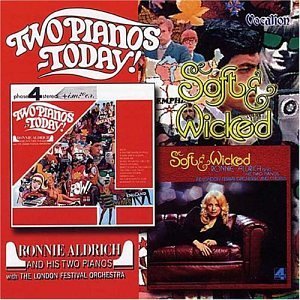
Ronnie Aldrich, His Two Pianos and the London Festival Orchestra give their take on the pop parade in these two delightful albums issued in 1967! On ‘Two Pianos Today’, Aldrich takes on the sounds of both the cinematic and chanteuse and turns them into signatures of his twin piano style. It works as fine samples of the Phase 4 stereo sound even in digital. What is more fascinating is that Aldrich sounds as hip as the chartbusters he covers. His paino never seems to fail in keeping up with the uptempo. The ‘switching’ between the two pianos add a surreal sense of pace and space between the musical notes: ‘Georgy Girl’ is a fine sample of this style, along with ‘Music to watch Girls By’ and ‘Somethin’ Stupid’. Some very interesting use of Mandolins on various tracks – echoing perhaps the motifs of ‘Never on Sunday’, a popular film from that period set in Greece. ‘Two Pianos in Hollywood’ take up this cinematic sound and adapt his pianos for a more string and orchestra ‘spectacular’ reminiscent of the golden screen era associated more closely perhaps with his contemporary, the arranger Stanley Black.

two pianos todayDECCA LP PFS 34132 (1967) STEREOwith the London Festival Orchestra
You Only Live Twice (Barry, Bricusse)
A Whiter Shade Of Pale (Reed, Brooker)
Georgy Girl (Springfield, Dale)
Somethin’ Stupid (Parks)
A Man And A Woman (Lai, Barough, Keller)
My Cup Runneth Over (Jones, Schmidt)
Don’t Sleep In The Subway (Hatch, Trent)
Release Me (Miller, Stevenson)
Barefoot In The Park (Hefti, Mercer)
Alfie (Bacharach, David)
Music To Watch Girls By (Ramin)
This Is My Song (Chaplin)
TWO PIANOS IN HOLLYWOOD ORIGINAL DECCA LP PFS 4108 (1967) STEREO
The Shadow Of Your Smile (Mandel, Webster)
Lara’s theme (Jarre, Webster)
Strangers In The Night (Singleton, Snyder, Kaempfert)
Chim chim cher-ee (R M & R B Sherman)
Limelight (Chaplin)
The Bible (Mayuzumi)
Who’s Afraid Of Virginia Woolf? (North, Webster)
The Moulin Rouge theme (Auric, Engvick)
More (Newell, Oliviero, Ortolani)
The Apartment (Williams)
The Patch Of Blue (Wayne, Goldsmith)
Lawrence Of Arabia (Jarre)
And just to complete Aldrich’s tour of the 1967-8, the album ‘For Young Lovers’ spins out more Burt Bacharach, Bobbie Gentry, Teddy Randazzo and Jimmy Web compositions that hogged the pop charts. This result is still pure magic as Aldrich’s piano never fails to capture the beat while keeping the spirit of lush…


FOR YOUNG LOVERSDECCA LP PFS 4141 (1968) STEREO
1.Ode To Billie Joe (Gentry)
2. What The World Needs Now (Bacharach; David)
3.Love Is Blue (Popp; Cour)
4. Sunny (Hebb)
5. (I Think I’m) Going Out Of My Head (Randazzo; Weinstein)
6. Impossible Dream (Darion; Leigh)
7. Baby, Now That I’ve Found You (Macaulay; Macleod)
8.Valley Of The Dolls (A & D Previn)
9. It Must Be Him (Becaud; David)
10. Up, Up And Away (Webb)
11. To Sir With Love (London; Black)
12. Born Free (Barry; Black)


Finally, who can forget Paul Mauriat’s ‘Blooming Hits’ LP from 1968 as the hippiest of the hip instrumental albums from 1968 – it is groove, groove, groovy from start to finish…capped of course by his smash ‘L’ amour est Bleu [Love is Blue]’. My other favourites are Mauriat’s version of ‘Somethin’ Stupid’ done Latin bolero style, ‘There’s a Kind of Hush’ and ‘Seuls au Monde’. Picture below shows the EMI 1998 remastered edition on CD!